Who We Are
McCalmont-Woods is an independent specialist commercial real estate agency founded to champion the interests of corporate occupiers exclusively in London’s prime office locations.
We help businesses with ambitious management teams to solve critical real estate issues and to optimize performance and cost savings in London.
What we do
We work with clients during phases of change, rapid development, innovation, organic growth and acquisition. We support management teams to enhance performance and efficiency and to achieve optimal results while remaining agile to meet the demands of an ever-changing business landscape.
We listen to your needs; we work with you on the planning; we help create a holistic plan for your real estate, and then we manage the process of translating process into action and execute the optimal solution.
Our story
The only constant is change.
Beginning: Jones Lang Wootton (1984-2000)
Nick McCalmont-Woods joined JLW as a graduate in its City of London office in 1984, initially to specialise in Lease Advisory and various related taxation work before transferring to the firm’s City Offices Agency team (advising both landlords and tenants), becoming a Partner in 1995. It was at JLW that Nick forged a long relationship with Cazenove & Co, one of the most prestigious stockbroking firms in the City of London, that would endure for 30-years.
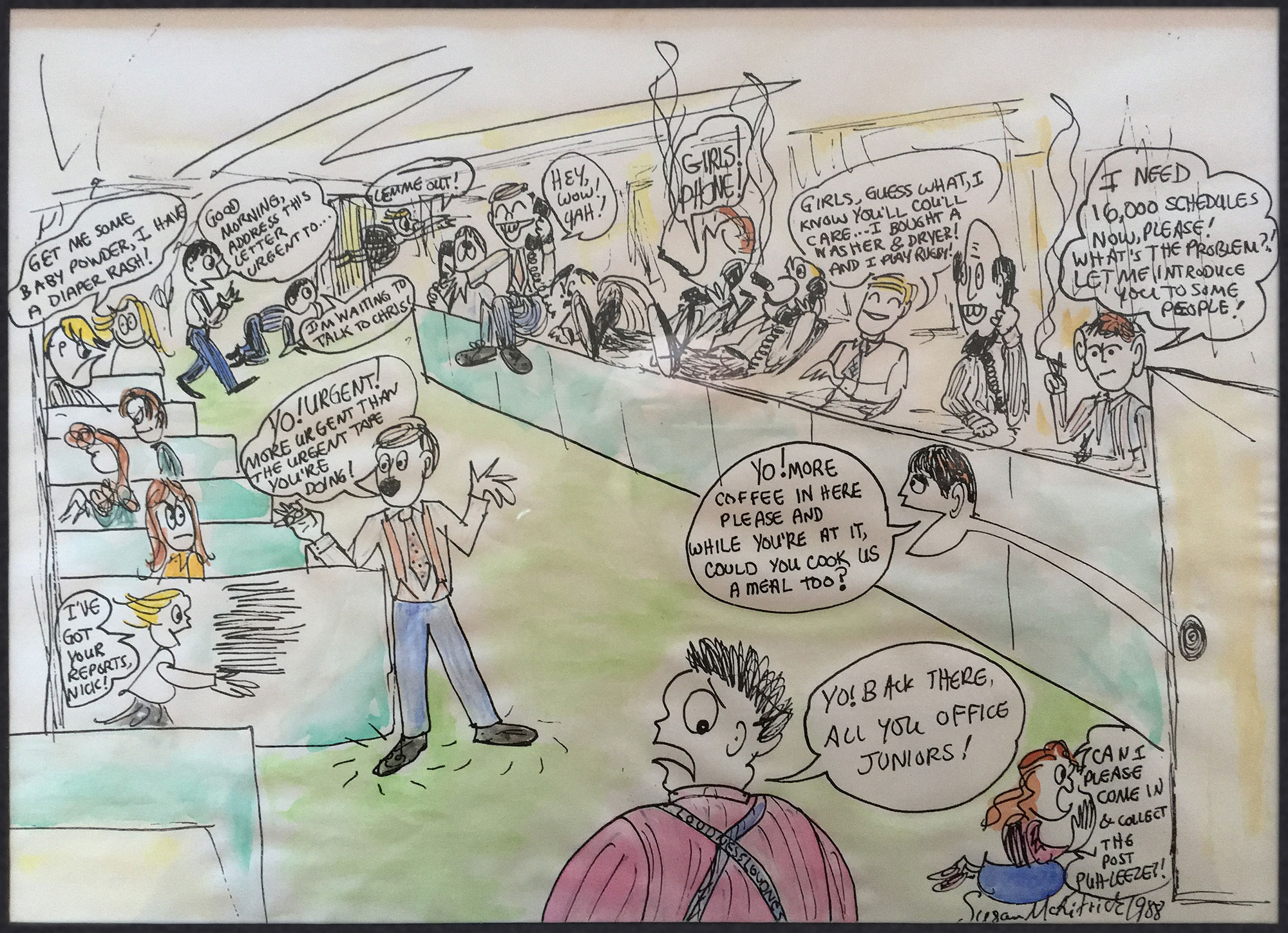
Drawing of JLW City Agency 1988 by Sue McKitrick (click image to enlarge).
Big Bang and globalisation
Between 1984 and 2000, the UK economy underwent sweeping transformation driven by financial deregulation, global capital flows, and rapid technological innovation. Central to this transformation was the ‘Big Bang’ deregulation of 27 October 1986, which abolished fixed commissions, opened the London Stock Exchange to foreign ownership, and replaced open‑outcry trading with electronic systems.
The surge of liquidity and financial innovation following Big Bang spilled into the UK real estate market, where rising capital flows and investor confidence fuelled commercial property investment and leasing activity. This momentum was abruptly checked by the 1987 ‘Black Monday’ stock‑market crash, which contributed to a cyclical downturn in property values as credit conditions tightened and investor sentiment cooled. The office market remained in the doldrums until the IRA’s Baltic Exchange (1992) and Bishopsgate (1993) bombs stimulated its recovery.
Concurrently, technology was reshaping business activity. The launch of the Apple Macintosh (1984) was soon followed by the widespread corporate adoption of personal computers. Tim Berner-Lee’s invention of the World Wide Web (1989) enabled early digital communication and information exchange, while the rollout of 2G digital mobile networks (from 1991) supported mobile voice and eventually data services. These innovations normalised the use of networked PCs, email, and digital databases, driving productivity and enabling new global business models with the enthusiasm for technology and growth culminating in the dot.com boom of the late 1990s.
Intermediate: GVA Grimley (2000-2007)
After 16 years with JLW (by then JLL) Nick joined GVA Grimley to help grow its City of London office, becoming an Equity Partner in 2001 (still advising a range of property owners, investors and corporate occupiers).
Pre-credit-crunch boom
The UK economy had embraced globalisation. Corporate occupiers, especially in service-ordinated sectors, benefitted from steady economic expansion, which supported business growth, hiring, and increased spatial requirements evident in the number of office pre lettings (37 > 150,000 sq ft) negotiated in the period 2000 to 2006.
However, not everyone benefitted. When the City market took a major downturn at the beginning of 2001 various corporate occupiers needed to affect significant cost reductions in their business. Telecommunications giant Cable & Wireless plc sought to reduce its UK headcount by 2,700 personnel by the end of June 2001 as part of a global cost cutting exercise. Between 2001 to 2004 Nick McCalmont-Woods managed the disposal of nine surplus office buildings for C&W across central London to include both its global HQ and its UK HQ in London’s Midtown district, generating much needed savings for the business.
While the environment of economic confidence fostered upgrading of premises, relocations to higher‑quality buildings, and competition for well‑located space in major cities and particularly in London, the onset of the credit freeze in late 2007 marked a sudden end to this growth period.
Present: McCalmont- Woods (2008+)
McCalmont-Woods was founded in Canary Wharf in early 2008 to champion the interests of corporate office occupiers in London’s prime real estate locations. In Q2 the UK entered its longest recession since records began and then in Q3 Lehman Bros collapsed heralding the start of the Great Recession. Since then, and after almost two decades, MWRE continues to provide independent conflict-free solutions for office tenants and buyers exclusively, having delivered more than £75M ($100m) in savings for clients to date.
Structural change and AI
Since 2008, the UK economy has undergone a profound structural transition shaped by the global financial crisis, Brexit, and the impact of the global pandemic on where and how we work. Generative AI and emerging technologies have become increasingly important as a driver of change for businesses, redefining the way in which corporate occupiers think about real estate.
Notable achievements
20 Moorgate Pre‑Let Acquisition – An Industry First
SIOR European Regional Chapter – top office transactions 2021 and 2024